

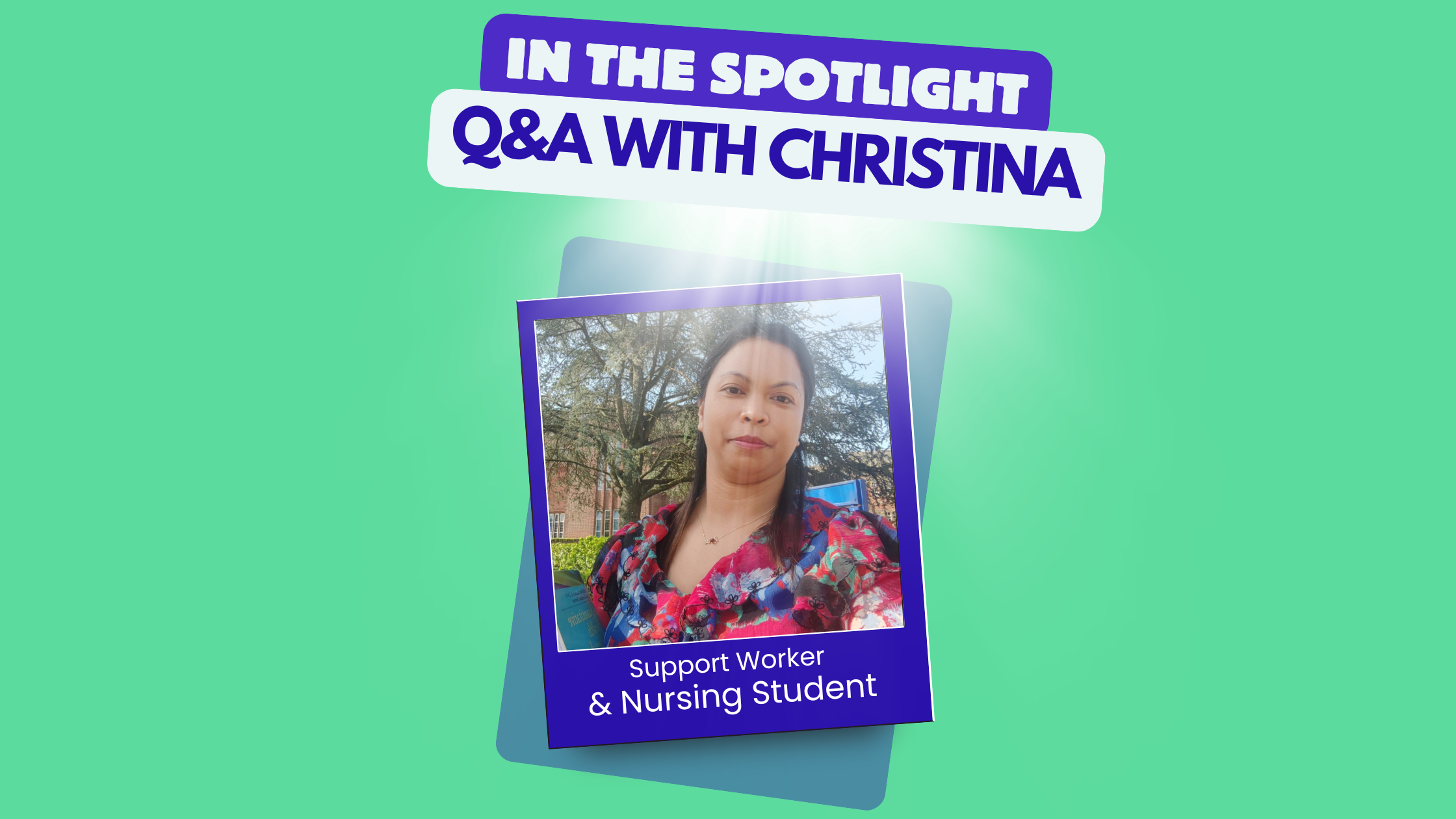
A closer look at the people behind the care: Meet Christina
This month, we spoke with Christina, an experienced support worker whose career has taken her from teaching in the Philippines to complex care, children’s services, learning disabilities, mental health and more. Alongside her support work, she is completing an integrated master’s degree in adult and mental health nursing. We asked Christina about the personal experience that first brought her into care, the responsibility that comes with supporting vulnerable people and what she would say to anyone considering the same path.
Editor’s note: Christina’s answers have been lightly edited for clarity and repetition while retaining her wording and meaning as closely as possible. The examples are anonymised. Some passages discuss intimate care, suicide risk and safeguarding.
What kind of support work do you do?
I do support work for SNG, and the support I provide is quite mixed. Recently, I have been working much more on the children’s side, including work connected with Southampton Children’s Services and independent social workers.
Before that, I gained a wide range of support-work experience with people who have learning disabilities and mental health conditions. I have also worked in older-person care, complex care and, at times, forensic support work. I have done lots of different things.
How did you first get into support work?
I was a teacher in the Philippines, and I moved to the UK in 2016. My first job here was as a complex support worker, supporting people who were clinically in need of care, not only with the usual personal-hygiene support.
At the time, my father was very unwell and ended up in a critical care unit in the Philippines. He had a tracheostomy and needed care such as suctioning. I did not know anything about that, but I wanted to be able to offer advice and support to my mum and my aunt, who was looking after him. I wanted to come from a point of knowledge and experience rather than only being the person who provided for his care financially.
That is how I ended up in complex support work. I wanted to be able to guide my family based on knowledge, science, research and experience, and to understand how care could be given properly and safely.
What do you enjoy most about being a Support Worker?
It is the realisation that I am actually able to make a difference to the person, or to the people, I look after. When somebody says that, it can sound like a cliché because you hear it so often, but there have been times when I have truly realised that the work is making a difference.
I am proud of what I am able to give at my current capacity, and I look forward to being able to do more.
Can you share a moment or a story that has stayed with you?
In 2020, I had a client with a spinal injury. With people who have a spinal injury, it is quite possible that they cannot push out their stool because they no longer have the muscle movement to do it.
As his support worker, I carried out what is called manual evacuation. I realised then that this person did not choose for this to happen to him. He would never, at 50 years old, have dreamed that one day somebody would come to his house and do this for him. I had to approach sensitively and professionally. I supported him for about two years and I realised what a difference I truly have made here. That makes me quite emotional and also proud.
It is not always about doing something as big as that. Many of the clients I support now are children, and they might not appreciate your presence or what you do for them, such as when you have to call the police or raise the alarm. But you know that you are doing your bit to keep them safe and give them a chance of a better future.
For example, with children who are actively suicidal, you are making sure that they live another day. You are giving them a chance to fight back for a future they may not have if you were not there doing your job. That is what I love about what I do.
What has been the biggest challenge in your role, and how do you handle it?
As an immigrant, one of the biggest challenges has been learning the legislation and understanding why we need to do the things we have to do. It also means continually educating yourself. They always say that ignorance is never an excuse.
If somebody tells you, ‘This is the right way’, you still need to double-check, is this really the right way of doing it, and what is the rationale? When you look after children, there is quite a lot to know. You cannot simply do what your common sense tells you all the time.
Your actions should be backed by the relevant legislation or local policies. Knowing those things gives you a good standing and helps you know that you have covered the possibilities.
You also have to make sure you read the documents you are given properly. If you have questions, you need to know the right people to ask. You did not study law, so you are not going to learn everything in one day. It comes from having the right people to contact, building experience and pre-empting what information or resources you may need.
What advice would you give to someone thinking about becoming a Support Worker?
Enjoy your work, but understand that you must be able to meet the needs of the person or young person you are supporting. It is not only about cooking for them or providing the basics. You have to provide social support as well.
Do not just sit there on your phone. Actually get to know the person. Talk to them so that you can provide person-centred care. If you get to know them, your support will have more impact.
Try to establish a good relationship, but do not cross the boundary. Always remain professional. That comes with experience, and it also helps when somebody is willing to tell you, ‘Hang on, you have crossed the boundary’. It is impossible to do everything right all the time, but it is possible to learn from your mistakes.
If you say you learned something from an experience but do not apply it the next time, then that is not true learning.
What are you working towards next?
Alongside support work, I am doing an integrated master’s degree in adult and mental health nursing. It is a four-year course, and I am currently in my third year. I expect to finish in June or July 2027.
When I qualify, I will be both a general adult nurse and a mental health nurse. I am proud of what I can give now, and I look forward to being able to do more.
What do you value about working with the SNG team?
SNG is very good at supporting its employees. I have worked with a lot of companies, and I think SNG is the most engaged. You really do take care of your employees.
It is not just about a token gesture at Christmas. It is more about what you do every day. You make us feel that you are always going to be there when we need help and that you are just a text or a call away. That is always how you have come across, so thank you very much for doing what you do.
Thank you, Christina, for your time, your honesty and the care, thoughtfulness and professionalism you bring to every shift. We are proud to have you on the team.
Want to find out more about working with SNG Healthcare? Get in touch at www.snghealthcare.co.uk
S.N.G Healthcare | Support Worker Spotlight